Skip to content





More and more children are getting their first mobile phone or smartphone at an early age. But research shows that over 50% of children have been contacted by strangers online, and 40% have received sexual or violent content. Is a smartwatch a safer choice?
Choosing the right technology for your child can be a challenge. Mobile phones provide easy communication, but can also lead to screen addiction and exposure to inappropriate content. For many parents, a smartwatch with GPS can be a safer alternative that lets your child stay connected without the same risks as a mobile phone.
When should a child get a mobile phone?
There is no set rule for when children should get their first cell phone. The choice depends on maturity, family needs, and how much contact the child needs. For example, children who go to school alone, have friends far away, or live in two homes may benefit more from a smartwatch or phone, but only if it is without or limited exposure to digital media, depending on their age.
Recommendations by age – when is a mobile or smartwatch relevant?
There is no right age to give your child a mobile phone or smartwatch. It's about maturity, everyday life and the need for contact. Here are our recommendations:
- 4–6 years: Basically no device – but a smartwatch without internet may be relevant in special cases, for example if the child needs to be able to call home or has shared residence.
- 7–9 years: Assess the need. A smartwatch without internet access is often a safe and child-friendly solution that strengthens the child's independence.
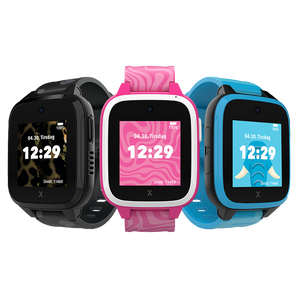
- 9–12 years: A natural time to introduce a communication device. Here, the XploraOne is a good alternative as a simple mobile for children , as it comes without access to social media and with features like GPS and school mode.
- 13 years+: As a starting point, Xplora still recommends reducing access to the internet and social media, but an alternative is a mobile phone with limited access to social platforms that can be controlled with a parental app or similar.
Our products are developed with a focus on safety, balance and digital education – so children can gain more responsibility, without exposure to digital media too early. Read the most important considerations you should make when choosing a smartwatch for children.
But mobile phones can also lead to distraction, screen addiction and social pressure. A smartwatch from Xplora is a good alternative – the child can call and send messages to approved contacts, while parents have full control over the functions.
Read more about our smartwatches for kids
Worrying statistics about children's mobile phone use
A new global survey of 25,000 parents and children shows that many parents experience challenges related to children's mobile use :
- 📌 51% of children have been contacted by strangers online.
- 📌 40% have received sexual or violent content.
- 📌 56% have experienced bullying or harassment online.
- 📌 52% feel addicted to the screen.
The study also shows that 54% of parents regret giving their child a smartphone too early, as it led to poorer sleep, less physical activity and reduced social interaction.

Smartwatch with GPS and calling capabilities
A smartwatch sits securely on the wrist and allows the child to contact parents and approved contacts. Xplora smartwatches have built-in GPS and SIM cards, so parents can easily see their child's location on a map. The watch also has call and message functions, a pedometer, a camera and an SOS button.
To avoid disruptions during school hours, school mode can be activated so that the watch only functions as a regular watch.
Smartphone or smartwatch for children?
There are several alternatives when your child needs a communication device. Here are some advantages and disadvantages of mobile phones and smartwatches:
Mobile Phone for Children – Advantages & Disadvantages
Advantages:
- Provides access to apps, internet and social media
- Can be used for schoolwork and learning
- More customization options with parental controls
Disadvantages:
- Can lead to screen addiction (52% of children feel addicted)
- Risk of inappropriate content (40% have received violent/sexual content)
- Greater risk of loss or theft
- More disruptions during school hours
Smartwatch for children – Advantages & Disadvantages
Advantages:
- Only approved contacts can call and send messages
- GPS and safety zones provide an overview
- No social media or open internet
- Long battery life, stays on the arm
Disadvantages:
- No apps or browser
- Can feel limiting as the child gets older
See our smartwatches for kids here
Many people get mobile phones at the age of 8
62% of children get their first mobile phone when they are between 8 and 10 years old, according to the Danish Media Authority.
- 22% get their own mobile phone when they are 8 years old.
- 19% get their own mobile phone when they are 9 years old.
- 21% get their own mobile phone when they are 10 years old.
At the same time, figures show that 16% of children already use an Xplora smartwatch as a safer alternative to a mobile phone.

Final words on when children should have a mobile phone.
Parents face an important choice when it comes to giving their child their first mobile phone . Smartphones offer many possibilities, but can also lead to challenges such as screen addiction and inappropriate content.
In Denmark, the government is continuously strengthening efforts to create a safer digital everyday life for children. Several initiatives are working towards mobile-free schools and a greater focus on how children use technology – both in education and in their free time.
In this development, child-friendly technological solutions are becoming an important complement. Products designed for children allow for contact and security without opening up social media or full internet access. This helps families support their child's independence in a way that is in line with national recommendations for a more balanced digital environment.


 Danmark
 Norge
Norge
 Sverige
 Suomi
Suomi